Tags
books, Buddhism, christianity, church, culture, God, graffiti, history, Joseph Campbell, Life, mythology, philosophy, poetry, pop art, Pop culture, psychology, religion, spirituality, street art, Tattoos, The Power of Myth, writing, Zen
“Knowledge does not enrich us; it removes us more and more from the mythic world in which we were once at home by right of birth.”—C.G. Jung, Memories, Dreams, Reflections,
In a world saturated with reason, ideas, facts and systems, to mention the Power Of Myth is to come off as slightly cracked, light headed, and laughably irrelevant. Even psychology despite being immeasurably advanced a century ago by the work and teaching of C.G. Jung has eschewed myth for a jargon-rich but ultimately clueless science.
Listen to this: “When something wonderful occurs, our brain’s reward center, the nucleus accumbens, fires up, releasing a flood of dopamine – the “feel-good” neurotransmitter.”
Wow, sounds formidably smart. But that’s the problem. It’s an often well paying superficial intelligence that masks the fact that it is meaningless and spectacularly uninsightful when it comes to… Life.
Sit on a park bench and watch the people strolling by and without being labelled a creep take note of their tattoos, their medallions, pendants and rings, and even their clothes and you will find yourself surrounded by the language of myth.
Here in Montreal there is an empty church on every corner. To me the language of myth that once formed a coherent narrative and helped build these majestic old stone temples has spilled out into the streets and is tattooed on people’s shoulders, arms, legs and ankles.
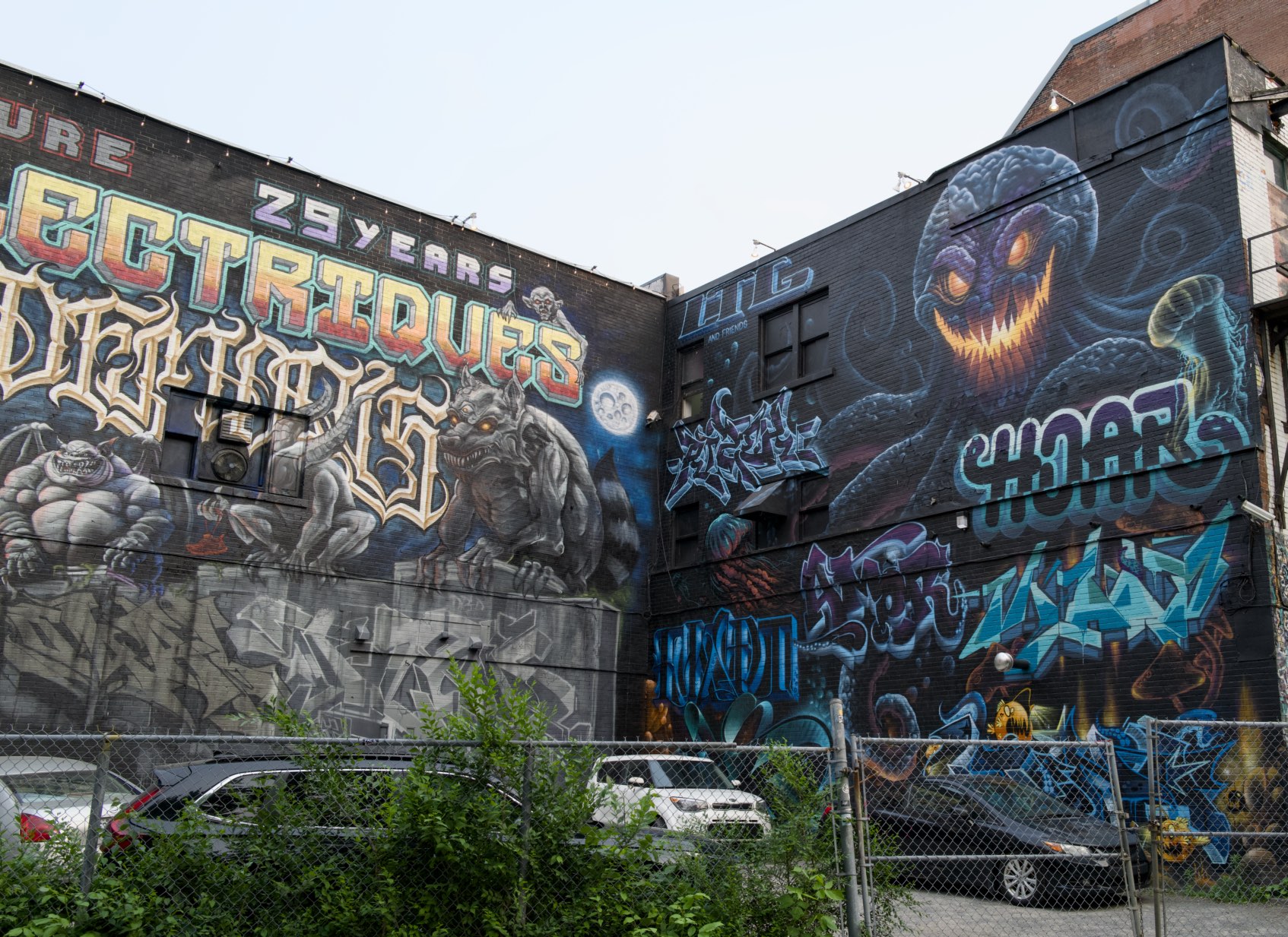
I see it scattered about the city inked on skin, worn as jewellery, donned as clothing and painted on countless surfaces by midnight expressionist scrawlers.
And of course it permeates the pop culture, film, fantasy, sci-fi, and comics we—and especially our young—consume.
It is all to do with the Power Of Myth and it is waiting to one day be composed into a new collective hymn.
Where do you see and experience the language of myth? Let’s have fun with it at omphaloscafe@gmail.com.
 Omphalos Cafe